
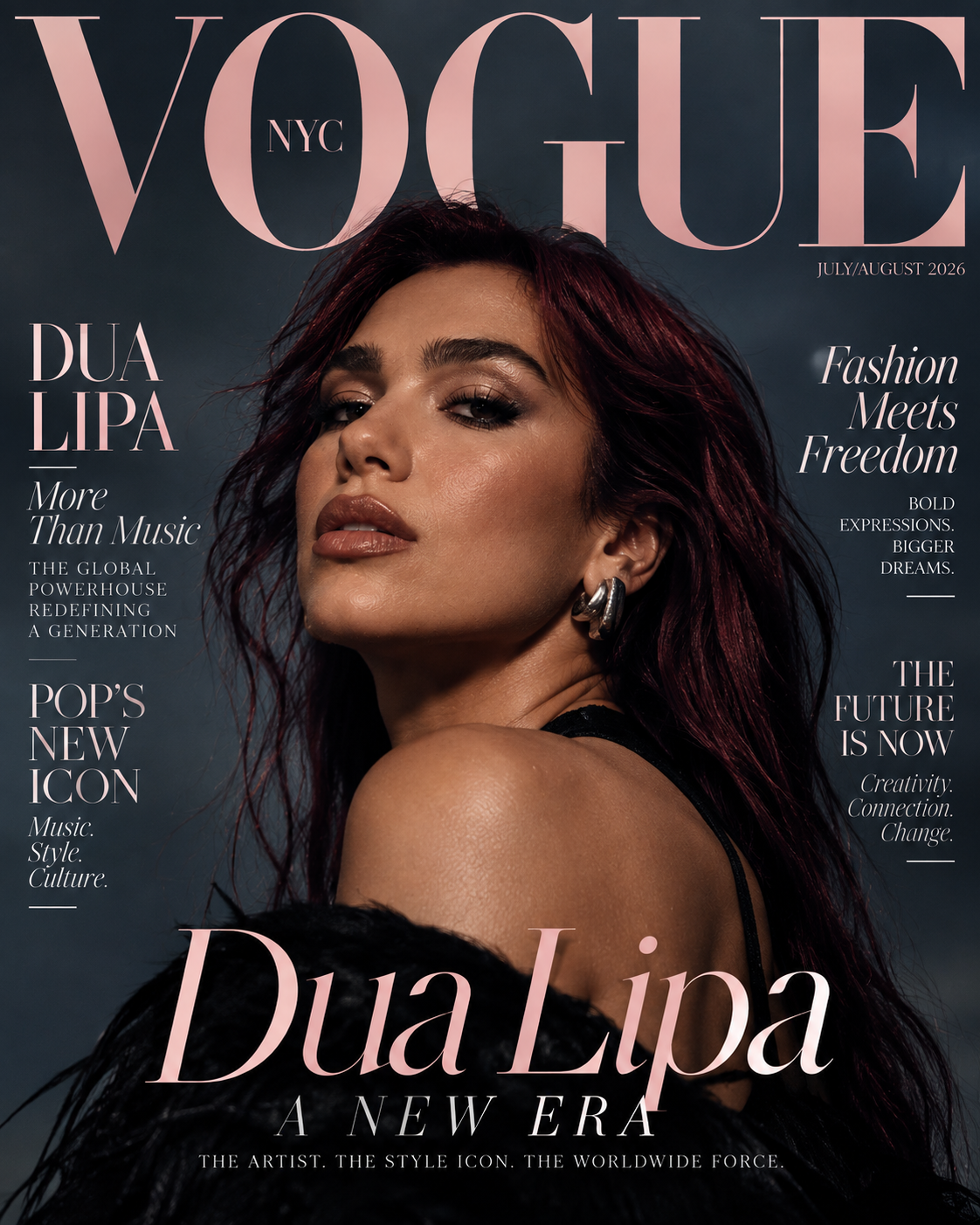
The Artist Who Turned Pop Stardom Into a Cultural Movement
Few contemporary artists have managed to occupy the worlds of music, fashion, and popular culture with the confidence and consistency of Dua Lipa. More than a successful recording artist, she has developed into a global cultural figure whose influence extends far beyond the stage. Her image represents a generation that values individuality, creative freedom, and the ability to move effortlessly between different forms of expression.
The cover presented here captures that evolution with a striking editorial vision. Set against a dark, sophisticated backdrop, Dua Lipa appears confident and composed, while the soft pink typography creates a contrast between modern glamour and classic fashion-magazine elegance. The central message—“A New Era”—suggests something larger than another chapter in a pop career. It speaks to transformation, maturity, and the continuing reinvention of an artist who refuses to remain defined by a single identity.
For Dua Lipa, music may have been the foundation, but style, culture, and creative independence have become equally important parts of her story.
From Pop Sensation to Global Powerhouse
Dua Lipa’s rise has been remarkable because it was never built around a single moment. Her career developed through persistence, distinctive artistry, and a sound that gradually established its own identity within modern pop.
Her early work introduced audiences to a powerful voice and a confident artistic personality. As her career developed, she began moving beyond the expectations traditionally placed on young pop singers. Instead of relying solely on vocal performance, she cultivated a complete visual identity—one that connected music with fashion, photography, choreography, and storytelling.
This approach became especially important as the global music industry changed. Audiences no longer experience artists exclusively through albums or concerts. Music exists alongside social media, fashion campaigns, interviews, music videos, red-carpet appearances, and digital communities.
Dua Lipa understood this environment exceptionally well.
Her public image became recognizable without feeling static. She could appear glamorous on a fashion cover, energetic on stage, sophisticated at an awards ceremony, or relaxed in a more personal setting, while maintaining an unmistakable sense of identity.
That flexibility has helped transform her from a pop singer into a global brand.
More Than Music
The phrase “More Than Music” featured prominently on the cover captures an important element of Dua Lipa’s appeal.
Music remains at the heart of her career, but her influence increasingly operates across several creative industries. Fashion is one of the most visible examples.
She has repeatedly demonstrated an understanding of fashion as a form of communication. Clothing, styling, makeup, hair, and photography all contribute to the character she presents to the world. Rather than simply following trends, she often approaches fashion as an extension of her artistic personality.
This is particularly powerful in an era when musicians and fashion houses increasingly exist within the same cultural ecosystem.
The modern pop star is expected to be visually compelling. Album campaigns have become fashion campaigns. Music videos resemble short films. Concerts are immersive productions. Red-carpet appearances generate global conversations within minutes.
Dua Lipa has embraced this transformation naturally.
Her fashion choices frequently balance confidence with experimentation, allowing her to move between vintage influences, contemporary glamour, streetwear, and high-fashion aesthetics. The result is an image that feels both current and personal.
Fashion Meets Freedom
The cover’s statement, “Fashion Meets Freedom,” offers another perspective on her influence.
For Dua Lipa, fashion appears less like a set of rules and more like a creative playground. This attitude reflects a wider cultural shift among younger audiences, who increasingly view personal style as an expression of identity rather than a requirement to conform.
Fashion can communicate confidence without words. It can challenge expectations, celebrate individuality, and create an atmosphere around an artist before the first note of a song is even heard.
Dua Lipa’s relationship with fashion demonstrates this idea clearly.
Her most memorable looks often work because they feel deliberate rather than accidental. They create a visual language that complements her music and personality. Whether through dramatic silhouettes, bold styling, minimalist elegance, or nostalgic references, she has established herself as someone willing to experiment.
That willingness to experiment is important because fashion, like music, depends on evolution.
An artist who repeats the same visual formula eventually becomes predictable. Dua Lipa’s continued relevance comes partly from her ability to change while remaining recognizable.