
A New Chapter in Modern Fashion
Fashion has always been about more than clothing. At its most powerful, it becomes a language—a way of expressing identity, confidence, creativity, and cultural change. Few contemporary figures embody that idea as naturally as Bella Hadid. With her distinctive presence, evolving personal style, and remarkable ability to command attention both on and off the runway, Hadid has become one of the defining faces of modern fashion.
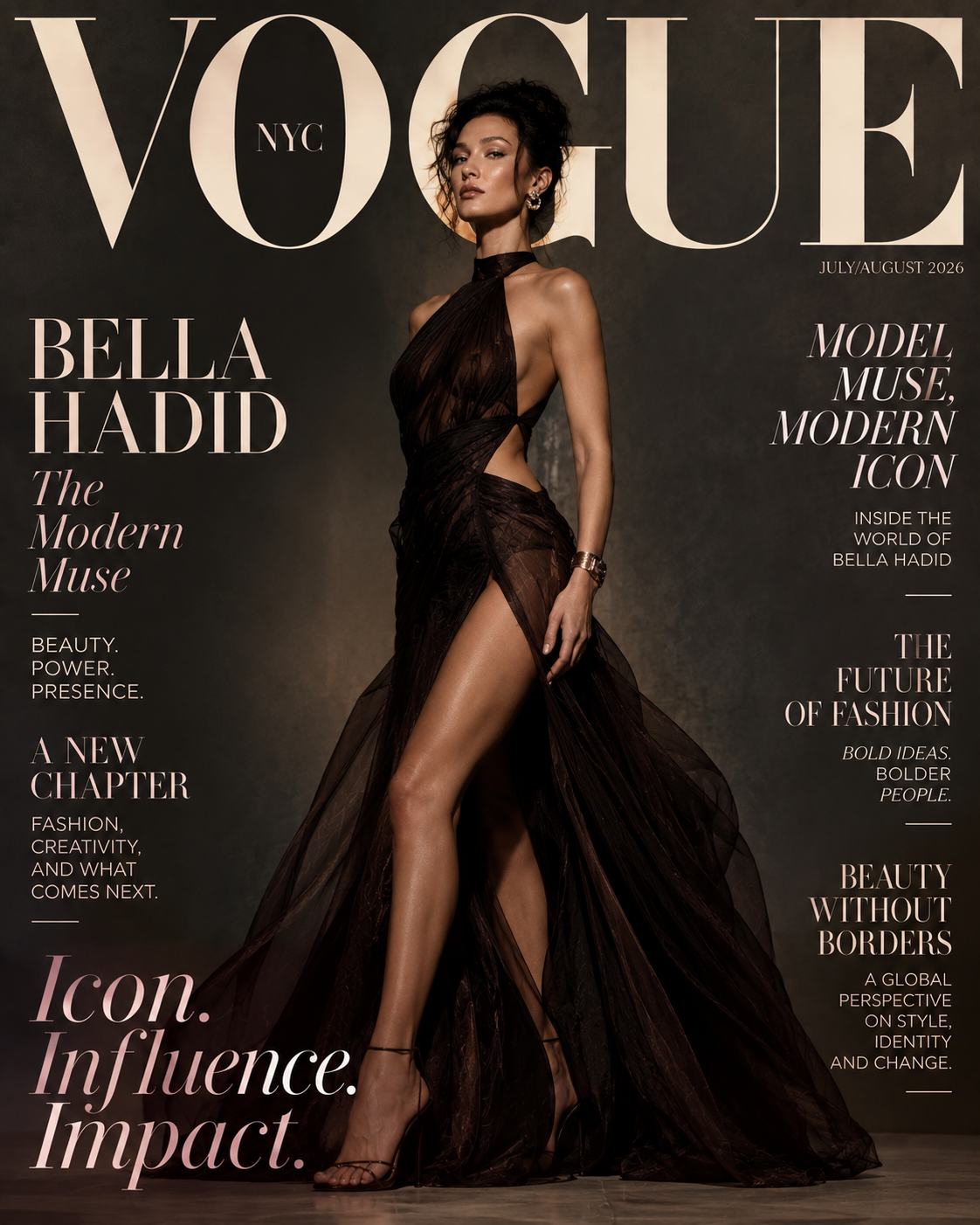
The cover image featuring Bella Hadid presents her not simply as a model, but as a modern muse. Dressed in an architectural black gown that combines transparency, movement, and dramatic draping, she stands against a dark, atmospheric background. The visual immediately communicates the themes surrounding her: beauty, power, presence, influence, and transformation.
The July/August 2026 cover concept captures a woman who has moved beyond the traditional boundaries of modeling. Bella Hadid represents a generation of fashion figures who are not merely photographed wearing clothes but actively participate in shaping the conversation around style, individuality, and contemporary culture.
The Power of a Distinctive Presence
There are countless models in the fashion industry, but only a small number develop an identity that remains recognizable beyond the runway. Bella Hadid belongs to that select group.
Her appeal has never depended solely on conventional beauty. Instead, it comes from the combination of attitude, versatility, and an unmistakable visual identity. She can move effortlessly between high-glamour editorials, minimalist street style, avant-garde fashion, and classic red-carpet elegance.
That versatility has made her particularly valuable in an industry where transformation is essential. Fashion constantly changes, and the models who remain influential are often those capable of changing with it without losing their identity.
The cover’s styling reflects exactly that balance. The black gown is sensual yet sophisticated, dramatic without appearing excessive. Its flowing fabric creates movement while the structured silhouette emphasizes strength. The result is an image that feels both timeless and distinctly contemporary.
Bella’s presence gives the garment its personality.
From Runway Model to Cultural Figure
Bella Hadid’s influence extends far beyond individual fashion campaigns. Over the years, she has become part of a broader cultural conversation about what it means to be a modern fashion icon.
The traditional model was often expected to disappear behind the designer’s vision. Today’s most influential models increasingly do the opposite. Their personalities, perspectives, personal aesthetics, and public identities contribute to the meaning of the brands they represent.
Hadid exemplifies this evolution.
She has developed a reputation for experimenting with fashion rather than simply following trends. Vintage references, modern tailoring, understated basics, bold accessories, and dramatic couture have all appeared within her broader style vocabulary. This willingness to explore different aesthetics has allowed her to appeal to both established luxury audiences and younger generations discovering fashion through digital platforms.
Her influence is therefore not limited to the runway. It exists in photographs, social media conversations, street style, advertising campaigns, red-carpet appearances, and the constantly moving visual culture of the internet.
The Art of Reinvention
One of the most important qualities represented by the cover is reinvention.
Fashion rewards novelty, but meaningful reinvention requires more than changing clothes. It requires understanding how personal identity can evolve while remaining authentic.
Bella Hadid’s career illustrates this principle. Her image has continued to develop alongside the fashion industry’s changing expectations. Rather than remaining attached to a single aesthetic, she has demonstrated the ability to embrace different eras, moods, and creative directions.
The result is a sense of unpredictability.
That unpredictability is valuable. In an age when audiences encounter thousands of images every day, familiarity can quickly become forgettable. The ability to surprise becomes a form of influence.
The cover’s dramatic styling communicates this idea beautifully. The dark palette, sculptural silhouette, exposed details, and flowing train create an image that feels almost cinematic. It does not present Bella as someone simply wearing a dress. It presents her as the central character in a fashion story.
Beauty, Power, and Presence
The words associated with the cover—“Beauty. Power. Presence.”—are particularly significant.
Modern beauty is no longer defined by a single standard. The fashion industry has increasingly expanded its understanding of individuality, personality, identity, and self-expression. A contemporary fashion icon is expected to possess more than physical appeal.
Presence matters.
Presence is the ability to hold attention without demanding it. It is visible in the way a model walks, poses, looks into a camera, or occupies a space. Bella Hadid’s editorial work has often relied on precisely this quality.
In the cover image, her posture is controlled and confident. The composition gives her substantial visual space, while the dark environment allows her figure and gown to remain the primary focus. The photograph creates a sense of intimacy and authority at the same time.
It is a reminder that fashion is ultimately about communication.
A garment can be technically beautiful, but the person wearing it determines how that beauty is interpreted.
The Modern Muse
The concept of the muse has changed dramatically.
Historically, a muse was often imagined as someone who inspired an artist from a distance. In contemporary fashion, however, the muse is frequently an active participant in the creative process.
Bella Hadid fits this modern definition.
Her ability to inspire photographers, designers, stylists, beauty creatives, and audiences comes from her adaptability. She can represent different creative worlds without losing her own identity.
The cover’s phrase “The Modern Muse” therefore feels particularly appropriate. It suggests someone who does not simply reflect fashion but contributes to its evolution.
A modern muse can be glamorous and unconventional, polished and experimental, nostalgic and futuristic. Most importantly, she can move between these identities naturally.
That fluidity has become one of the defining characteristics of contemporary style.
Fashion’s Future: Bold Ideas, Bolder People
The cover also looks beyond Bella herself, presenting a larger question: Where is fashion going next?
The future of fashion will likely be shaped as much by people as by garments. Designers, models, artists, entrepreneurs, photographers, creators, and audiences increasingly influence one another.
Digital culture has accelerated this process. A runway collection can become a global conversation within minutes. A street-style photograph can influence trends internationally. A model’s personal styling can inspire millions of people before a traditional fashion magazine has even published its next issue.
This environment demands personalities who can exist across multiple platforms.
Bella Hadid represents that new kind of fashion figure. Her career has unfolded during a period when the boundaries between runway fashion, celebrity culture, social media, entertainment, and personal branding have become increasingly fluid.
The model is no longer simply the final element of a campaign.
She can become part of the story itself.
A Global Perspective on Style and Identity
The phrase “Beauty Without Borders” on the cover points toward another important transformation in fashion: its increasingly global perspective.
Style is no longer dictated by a handful of traditional fashion capitals. Inspiration now travels constantly between continents and cultures. Designers, artists, and audiences exchange ideas through digital platforms, travel, music, film, and popular culture.
This has created a more diverse fashion ecosystem in which identity can be expressed through combinations of influences.
Bella Hadid’s appeal fits naturally within this environment. Her fashion identity can shift from classic luxury to contemporary streetwear, from nostalgic references to futuristic silhouettes. Such versatility reflects a broader cultural reality: modern style does not have to belong to one category.
It can be personal, experimental, and constantly evolving.
The Importance of Personal Style
Perhaps one of the greatest lessons from Bella Hadid’s fashion journey is the value of developing a personal point of view.
Trends are temporary. Personal style lasts longer.
A person who simply follows every trend can easily become visually interchangeable. Someone who understands what works for them can turn even simple clothing into a recognizable signature.
Bella’s style demonstrates the power of contrast. She can embrace elaborate fashion while also appearing comfortable in more relaxed looks. She can combine contemporary pieces with vintage-inspired elements, creating an aesthetic that feels individual rather than manufactured.
This is especially relevant to younger fashion audiences, who increasingly view style as a form of storytelling.
What someone wears can communicate mood, personality, nostalgia, confidence, creativity, or even rebellion.
Fashion becomes a conversation between the individual and the world.
Beyond the Image
A fashion cover is ultimately a carefully constructed image, but its impact can extend far beyond the photograph.
Bella Hadid’s position within contemporary fashion illustrates how models have become important cultural figures in their own right. Their influence can shape conversations about beauty, confidence, individuality, and the relationship between fashion and popular culture.
The most successful fashion personalities understand that visibility alone is not enough. Influence comes from creating an emotional connection with audiences.
That connection may come through a striking photograph, an unexpected outfit, a memorable runway moment, or a distinctive personal aesthetic.
In Bella’s case, her continued relevance demonstrates the power of evolution. She has remained visually compelling because her image does not feel permanently fixed.
There is always room for another chapter.
Icon. Influence. Impact.
The final words of the cover—“Icon. Influence. Impact.”—summarize the larger story.
An icon is someone whose image becomes recognizable beyond a particular moment.
Influence is the ability to affect how people think, dress, create, or consume culture.
Impact is what remains after the moment has passed.
Bella Hadid’s significance within modern fashion can be understood through all three ideas. Her image has become recognizable across the fashion landscape, her style has inspired audiences and creative communities, and her career represents the continuing transformation of the model’s role.
The most interesting question is not simply what Bella Hadid will wear next.
It is what fashion will ask her to represent next.
A Lasting Place in the Fashion Conversation
The cover’s dark, sophisticated aesthetic creates a fitting portrait of a fashion figure defined by confidence and evolution. Bella Hadid appears not as a symbol of a single trend but as part of a larger movement toward individuality, experimentation, and personal expression.
Her story reflects the changing nature of fashion itself.
The industry no longer belongs exclusively to designers, editors, or traditional institutions. It is shaped by personalities, communities, digital audiences, and cultural movements. Models are no longer simply faces attached to clothing. At their most influential, they become storytellers.
Bella Hadid has demonstrated the ability to occupy that space.
The modern fashion icon is not expected to remain unchanged. She is expected to evolve, challenge expectations, embrace new ideas, and remain recognizable while becoming something new.
That is what makes the image of Bella Hadid on this cover so compelling.
She stands surrounded by darkness, yet commands the entire frame. The gown moves around her, but never overwhelms her. The styling is dramatic, but her presence remains the strongest element.
It is an image of confidence, transformation, and possibility.
And perhaps that is the true meaning of a modern muse: not someone who represents fashion exactly as it is, but someone who inspires us to imagine what it could become.